
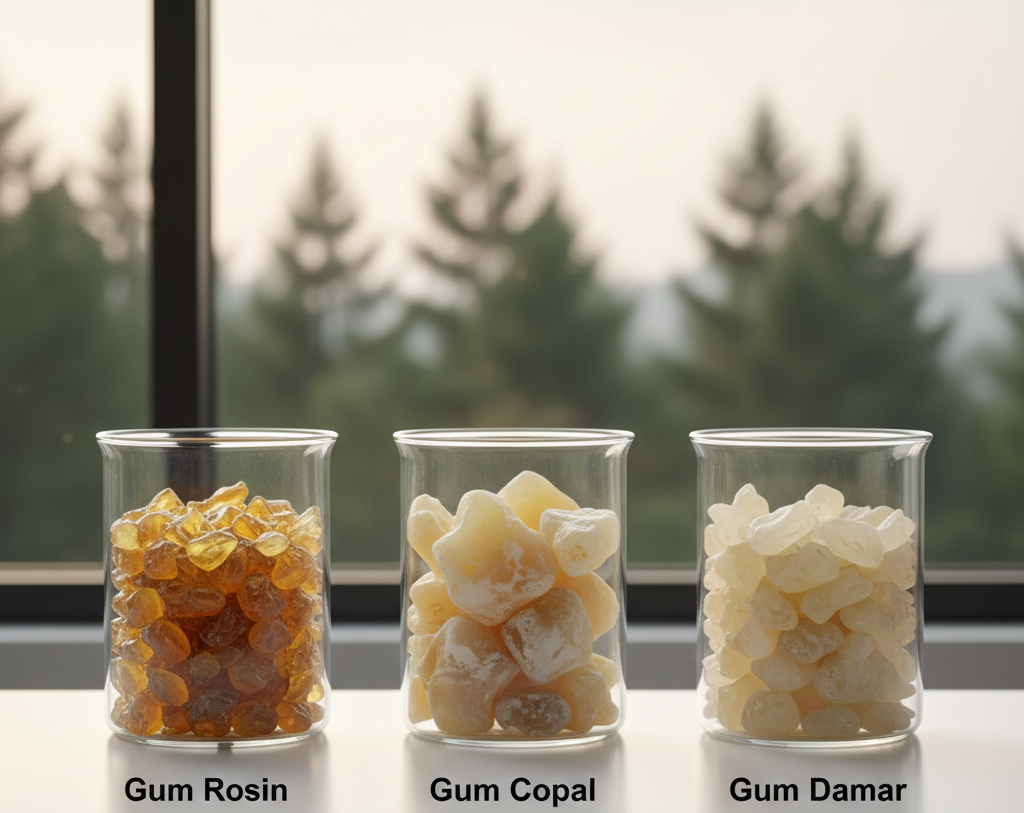
Introduction: One Family, Three Very Different Resins
Formulators in adhesives, inks, varnishes, and coatings often talk about “pine‑based” or “natural resins” as if they were all the same. In reality, gum rosin, gum copal, and gum damar each have distinct properties that make them suitable for different end uses. Choosing the wrong one can affect film quality, gloss, drying time, and even regulatory compliance.
As a supplier of Indonesian non‑wood forestry products, PT N.A.V.A.L provides all three resins and helps customers worldwide select the most suitable grade for their formulation and processing needs.
What These Resins Have in Common
Gum rosin, gum copal, and gum damar are all natural resins derived from trees and classified as non‑timber forest products (NTFPs). They are typically produced by tapping living trees for resin or by collecting naturally exuded or fossilized resin, then cleaning and grading it.
Because they are bio‑based and renewable, these resins help manufacturers reduce reliance on purely petrochemical inputs while maintaining performance in demanding industrial applications such as coatings, inks, and adhesives.
Gum Rosin: The Workhorse Resin for Adhesives and Inks
Gum Rosin from Indonesia is a natural organic compound obtained by distilling oleo pine resin tapped from pine trees. It appears as a yellowish, transparent solid and is available in commercial grades such as WW and X with controlled acid and softening values.
Key characteristics:
- Acid value: typically 160–190
- Softening point (Ring & Ball): around 78–80 °C minimum
- Appearance: transparent solid, slightly yellow to yellow
- Uses: paper, paint, polishing, phenyl, explosives, soaps, crackers, rubber, ink, solder flux, synthetic organic intermediates, glazing agent in medicine, chewing gum, and beverages.
Gum rosin is often the first choice when high tack, excellent film‑forming properties, and good compatibility with many polymers and oils are required, especially in adhesives and printing inks.
Gum Copal: Hardness and Gloss for Varnishes and Specialty Coatings
Gum Copal is a natural resin found mainly in Sulawesi and Java, where it is valued for its hardness and clarity. Its quality is judged primarily by hardness, lump size, degree of purity, and color, and PT N.A.V.A.L supplies grades such as PWS, DBB, WS, and dust.
Typical characteristics:
- Appearance: whitish yellow (PWS), blackish yellow (WS), yellow (DBB)
- Purity: up to 99–100% for higher grades
- Solubility: generally soluble in suitable solvents for coatings
- Uses: lacquers, varnishes, paints, dental fillings, paper coating, linoleum, adhesives, and similar products.
Gum copal is commonly selected for applications that require a hard, glossy film and good durability, such as wood varnishes and specialty protective coatings.
Gum Damar: Clarity and Flexibility for Coatings, Cosmetics, and Food
Gum Damar is a resin obtained from tree families in India and East Asia, particularly the Shorea and Hopea clans, and is produced mainly by tapping trees or collecting fossil resin. It is supplied in grades such as ABX and CDX with strict control over color, ash content, and solubility.
Key characteristics:
- Appearance: white to pale yellow solid resin
- Colour (Gardner): below 0.5, indicating very light color
- Solubility: insoluble in water, freely soluble in toluene
- Uses: raw material for paint, ink, varnish, coatings, cosmetics, and as a clouding or glazing agent in food industry applications.
Because of its clarity and light color, gum damar is often preferred in clear or lightly tinted coatings, cosmetic formulations, and certain food‑contact uses where appearance is critical.
| Feature / Aspect | Gum Rosin (Gondorukem) | Gum Copal | Gum Damar |
|---|---|---|---|
| Source | Distillation of oleo pine resin from pine trees | Natural resin from trees in Sulawesi and Java | Resin from Shorea/Hopea trees in India and East Asia |
| Typical appearance | Transparent solid, slightly yellow to yellow | Whitish to yellow nodules depending on grade | White to pale yellow solid resin |
| Key grades | WW, X | PWS, WS, DBB, dust | ABX, CDX |
| Main properties | High tack, good film‑forming, acid value 160–190 | High hardness, good gloss, purity up to 99–100% | Very light color, good clarity, soluble in aromatic solvents |
| Typical uses | Paper, paint, soaps, rubber, ink, solder flux, synthetic intermediates, glazing agent | Lacquers, varnishes, paint, dental fillings, paper coating, linoleum, adhesives | Paint, ink, varnish, coatings, cosmetics, food clouding and glazing agent |
| Best suited for | Adhesives, printing inks, rubber compounding, paper sizing | High‑gloss wood finishes and specialty varnishes | Clear coatings, cosmetics, and select food‑industry applications |
How to Choose the Right Resin for Your Application
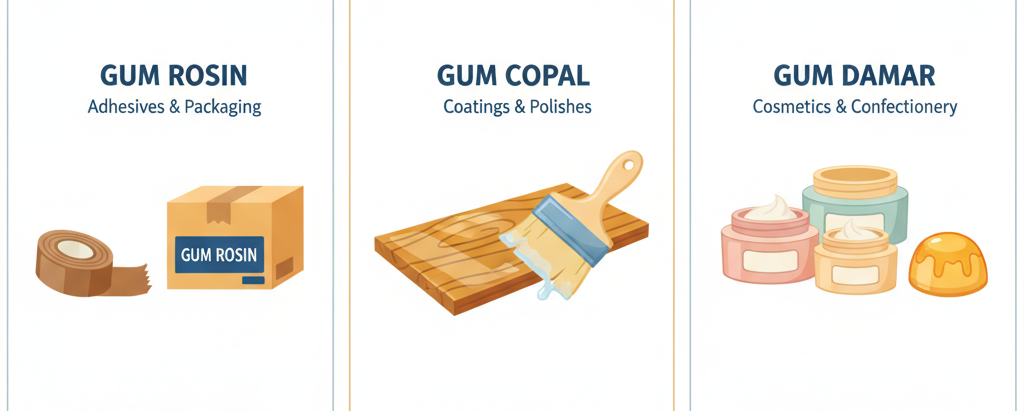
When deciding between gum rosin, gum copal, and gum damar, consider the following practical points:
- Performance requirements
- For high tack and adhesion in hot‑melt or pressure‑sensitive adhesives, gum rosin is usually the primary choice.
- For hardness and long‑lasting gloss in wood varnish and specialty coatings, gum copal offers a more suitable profile.
- For clear, light‑colored coatings and cosmetic or food‑related uses, gum damar stands out.
- Regulatory and end‑use considerations
- Applications in food and cosmetics must follow applicable regulations; gum damar is widely recognized as a glazing/clouding agent in some food contexts when permitted.
- Industrial coatings and inks have more flexibility and may use any of the three resins depending on solvent system and performance target.
- Processing and formulation constraints
- Check solvent compatibility and melting behavior relative to your existing formulation and equipment.
- Evaluate the impact on drying time, hardness, and color of the final film through lab trials.
By aligning resin selection with performance, regulatory, and processing needs, formulators can avoid costly reformulations and quality complaints.
Why Source These Resins From Indonesia and PT N.A.V.A.L
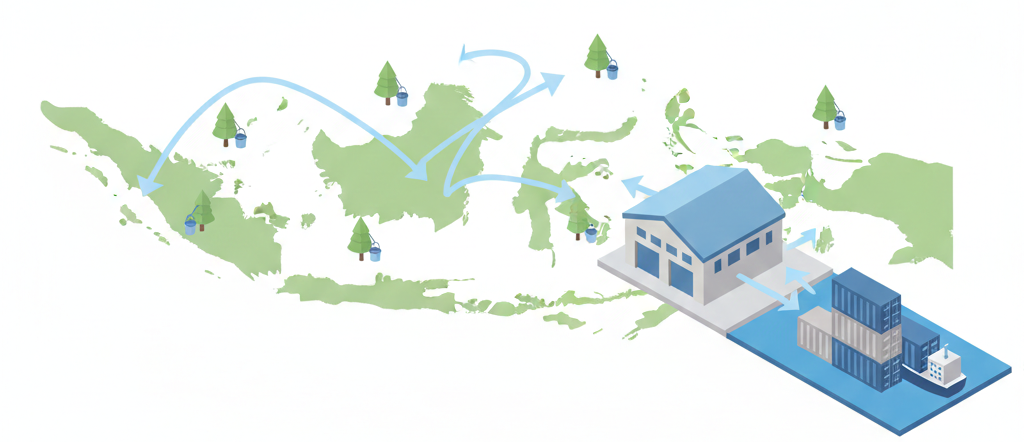
Indonesia has long been a major origin for natural resins such as gum rosin, gum copal, and gum damar, thanks to its extensive pine and hardwood resources and established tapping traditions. PT N.A.V.A.L consolidates this upstream strength with modern logistics, offering competitive packing options and containerized shipments suitable for global buyers.
With product pages and technical specifications available for gum rosin, gum copal, and gum damar, PT N.A.V.A.L can support customers across adhesives, coatings, inks, cosmetics, and food‑related industries in making the right choice for each formulation. Dedicated sales, purchasing, and technical contacts in Jakarta ensure fast communication and reliable supply.
Call to Action
If you are evaluating gum rosin, gum copal, or gum damar for new or existing formulations, PT N.A.V.A.L can help you compare grades, test samples, and design a supply program tailored to your plant and logistics needs. Contact our sales and marketing team at marketing@navalgroup.biz or reach us via our Jakarta office to discuss your resin requirements and request detailed specifications.